
How Much Power Do Your Appliances Use — And How Many Panels to Run Them?
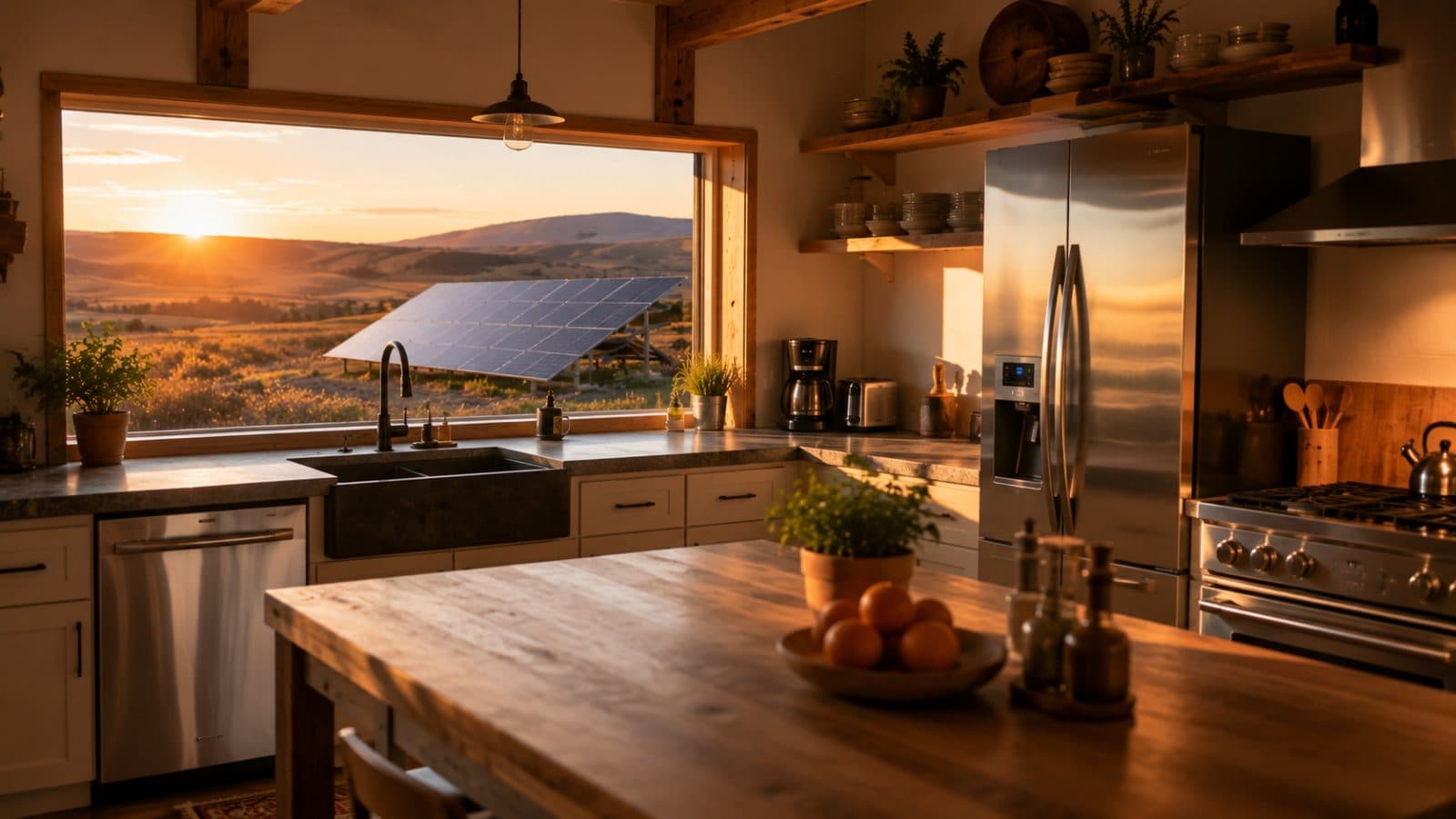
One of the most common questions we get at the counter is some version of: "How many panels do I need to run my fridge?" It's a great question — and the honest answer is "it depends on the appliance and the season." So let's put real numbers to it.
Below are typical energy figures for the appliances most people want to keep running, followed by a simple way to translate those into the number of used 300-watt panels you'd need here in eastern Washington — in summer versus the dead of winter. If you'd rather start with the basics, our panel-sizing framework is the quick version.
What common appliances actually use
Power draw (watts) is only half the story — what matters for solar sizing is energy used per day (kilowatt-hours, or kWh). A 1,500 W heater running 8 hours uses far more than a 150 W fridge running all day. Here are realistic daily estimates for typical, reasonably efficient appliances:
| Appliance | Typical power | Typical daily use | Energy / day |
|---|---|---|---|
| Refrigerator (full-size) | ~150 W (cycles) | All day | ~1.2 kWh |
| Chest freezer | ~120 W (cycles) | All day | ~1.1 kWh |
| Window A/C (10,000 BTU) | ~900 W | 8 hrs (summer) | ~7 kWh |
| Central A/C (3-ton) | ~3,000 W | 8 hrs (summer) | ~24 kWh |
| Electric space heater | 1,500 W | 8 hrs (winter) | ~12 kWh |
| Desktop computer + monitor | ~200 W | 6 hrs | ~1.2 kWh |
| Laptop | ~50 W | 6 hrs | ~0.3 kWh |
| LED lighting (whole home) | ~100 W | 5 hrs | ~0.5 kWh |
| TV (55" LED) | ~100 W | 5 hrs | ~0.5 kWh |
| Wi-Fi router + modem | ~12 W | 24 hrs | ~0.3 kWh |
| Well pump (1/2 HP) | ~750 W | ~1 hr | ~0.75 kWh |
| Microwave | ~1,000 W | ~20 min | ~0.3 kWh |
These are typical estimates for efficient, modern units. Your actual usage will vary with the specific model, how hard it works, and how long you run it. To check a specific appliance, the U.S. Department of Energy's appliance energy-use guide and energy calculator are excellent free tools, and the EIA tracks how U.S. homes use energy overall.
Turning kilowatt-hours into panels
A panel's nameplate wattage (say 300 W) is its output in perfect sun. In the real world you multiply by the number of strong "peak sun hours" your location gets, then knock off about 25% for inverter, wiring, temperature, and battery losses. To model this precisely for your address, NREL's free PVWatts Calculator is the industry standard.
Eastern Washington is genuinely sunny (more than its reputation suggests), but day length swings hard between seasons. Realistic planning numbers for the Oroville / Okanogan area:
- Summer: ~6 peak sun hours/day → one 300 W panel makes about 1.35 kWh/day (0.3 kW × 6 × 0.75).
- Winter: ~2 peak sun hours/day → one 300 W panel makes only about 0.45 kWh/day (0.3 kW × 2 × 0.75).
- Refrigerator (1.2) + chest freezer (1.1)
- Lights, TV, Wi-Fi (1.3)
- Laptop (0.3) + well pump (0.75)
- Microwave + odds and ends (~0.5)
- Summer: ~4 panels
- Winter: ~12 panels
That's the big takeaway: the same panel produces roughly 3× more in summer than in winter. Now divide each appliance's daily energy by those figures to get panels needed (rounded up):
| Appliance | Energy / day | Panels in summer | Panels in winter |
|---|---|---|---|
| Refrigerator | 1.2 kWh | 1 | 3 |
| Chest freezer | 1.1 kWh | 1 | 3 |
| Window A/C | 7 kWh | 6 | — |
| Central A/C | 24 kWh | 18 | — |
| Electric space heater | 12 kWh | — | 27 |
| Desktop computer | 1.2 kWh | 1 | 3 |
| Lights + TV + Wi-Fi | ~1.3 kWh | 1 | 3 |
Notice the two monsters: central A/C in summer and electric resistance heat in winter. Those alone can need 18–27 panels. If you're going off-grid, this is why people lean on propane, wood heat, or mini-split heat pumps for climate control rather than brute-force electric heat.
A real-world example: powering the essentials
Let's size a cabin that runs the day-to-day essentials — no central A/C, no electric furnace:
That's roughly 5.2 kWh per day. Translated to 300 W panels:
Same house, same appliances — three times the panels in January. The smart move is to size for your worst month (winter), or plan to lean on a generator for the few darkest weeks. For the full sizing walkthrough — including batteries and inverters — see our off-grid system sizing guide.
Don't forget the batteries
Panels only make power while the sun is up. To run a fridge overnight or a freezer through a cloudy stretch, an off-grid system also needs battery storage and an inverter. A good rule of thumb is to store at least one full day of your daily kWh — so that ~5.2 kWh cabin wants somewhere around 5–10 kWh of usable battery for comfort. The panels refill the batteries; the batteries carry you through the dark.
The bottom line
Most folks are surprised how few panels it takes to cover the essentials in summer — and how many more it takes in winter. Knock out the big loads first (skip electric heat and central A/C off-grid), size your panels for winter, add batteries to ride through the night, and you can keep the fridge cold and the lights on year-round.
The good news: you don't need new-panel prices to get there. Our used 310 W and 315 W panels are sourced from utility decommissions at $65–$70 each, and they hold up remarkably well. Want help sizing a system for your appliances? Browse our current stock, call or text us at (509) 341-0559, or stop by in Oroville and we'll run the numbers with you.
Figures above are planning estimates based on typical efficient appliances and approximate eastern Washington sun (about 6 peak sun hours in summer, 2 in winter) with ~25% system losses, using 300 W panels. Your real results will vary with your equipment, habits, and weather.
Ready to get your panels?
We have stock on hand in Oroville, WA. Local pickup, honest prices.
Shop Solar PanelsGet notified when new stock arrives
No spam. Just stock alerts and occasional sale notices.