
Watts, Amps, and Volts — Explained Without the Headache
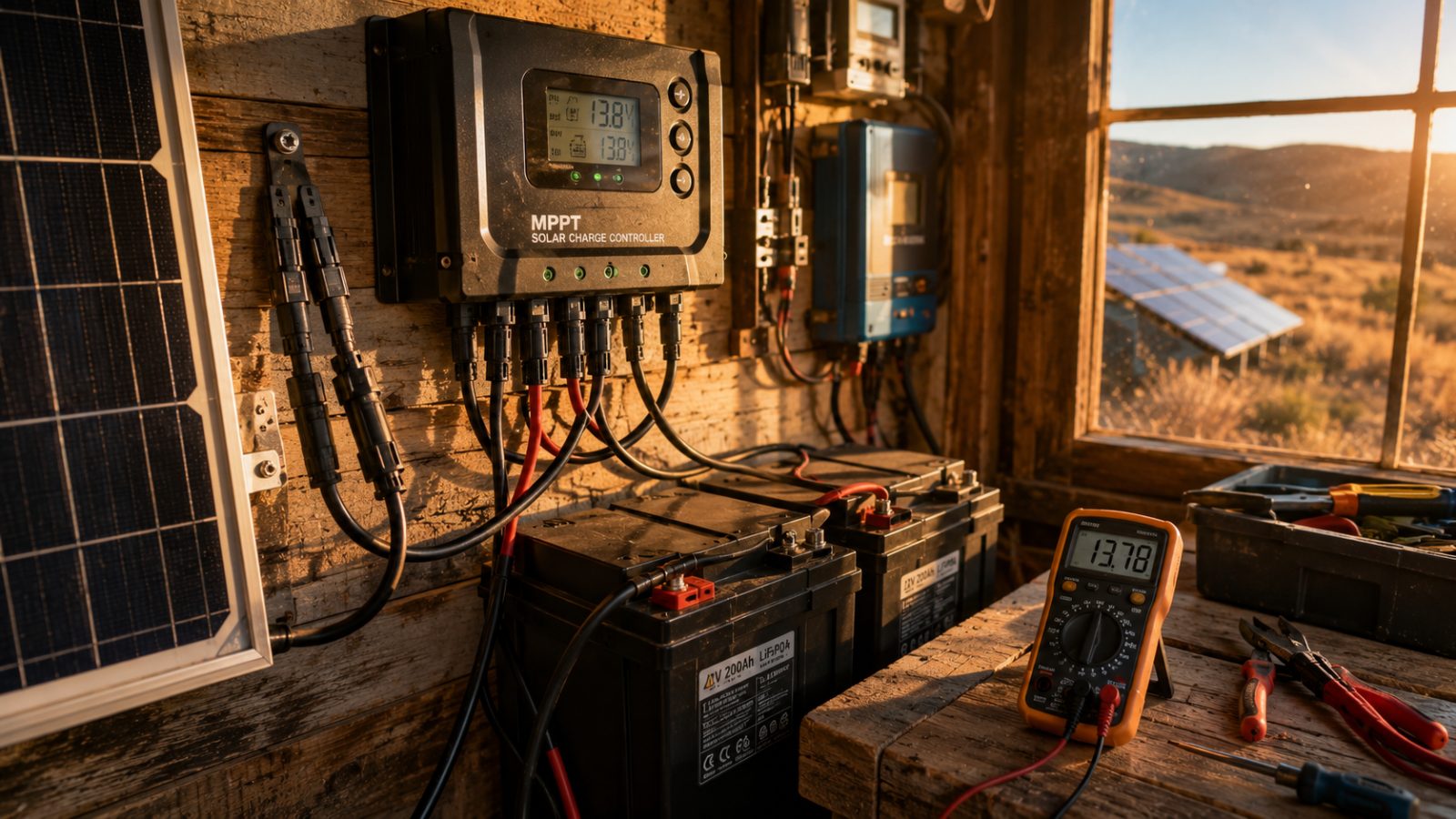
If volts, amps, and watts all blur together in your head, you're in good company. Most folks who come to us aren't electricians — they're homesteaders, cabin owners, and people who just want the lights to stay on. You don't need an engineering degree to build a solar system. You need three numbers and a feel for how they relate. Let's knock that out.
The water analogy that makes it click
Electricity flowing through a wire works a lot like water flowing through a hose. Hold that picture and the three units fall into place:
- Volts (V) = water pressure. It's the push — how hard the electricity is being shoved through the wire. More volts, more push.
- Amps (A) = flow rate. It's how much electricity is actually moving past a point — like gallons per minute coming out of the hose.
- Watts (W) = the actual work getting done. Pressure and flow combined. A trickle at high pressure or a flood at low pressure can both do real work — watts tell you how much.
- A panel pushing 37 volts at 8 amps is making about 300 watts (37 × 8 ≈ 300).
- A 12-volt water pump pulling 5 amps draws 60 watts.
- Run the math backward when you need to: a 1,200-watt load on a 120-volt outlet pulls 10 amps (1,200 ÷ 120).
- Volts set your system's "class" — 12V, 24V, or 48V — and decide things like how long a series string can get before it overwhelms your charge controller. Cold mornings actually raise panel voltage, so there's a little headroom math to respect.
- Amps decide how thick your wire and how big your fuses need to be. Push too many amps through too-thin wire and you get heat, voltage drop, and a fire risk. Higher-voltage systems move the same power at fewer amps, which is exactly why bigger off-grid builds run at 48V.
- Watts (and watt-hours) are how you size the whole thing: add up what your appliances draw, figure out how many hours you run them, and you've got your daily energy target.
The one formula worth memorizing
Here's the whole relationship in a single line:
Watts = Volts × Amps
That's it. Pressure times flow equals power. A few quick examples:
Quick reference
| Term | Unit | Water analogy | What it tells you |
|---|---|---|---|
| Voltage | Volts (V) | Pressure | How hard the electricity is pushed |
| Current | Amps (A) | Flow rate | How much is flowing right now |
| Power | Watts (W) | Total work being done | The real output — volts × amps |
Watts vs. watt-hours: power vs. how much you used
This trips up almost everyone, so it's worth a beat. Watts measure power at a single instant — how much is flowing right now. Watt-hours (Wh) measure how much electricity you actually used over time. As the U.S. Energy Information Administration puts it, one watt-hour is one watt of power used for one hour.
So a 60-watt light left on for 5 hours uses 60 × 5 = 300 watt-hours. That "energy over time" number is what you size your panels and batteries around — not the instantaneous wattage.
Batteries are usually rated in amp-hours (Ah), which is the same idea measured in flow instead of power. To turn amp-hours into watt-hours, multiply by the battery voltage: a 100 Ah battery at 12 V holds about 1,200 Wh (100 × 12). Just remember an amp-hour at 12 V and an amp-hour at 48 V are not the same amount of energy — always bring it back to watt-hours when you're comparing.
Why each one matters when you're off-grid
A real off-grid example
Say you want to run 60W of LED lighting for 5 hours, a laptop at 50W for 3 hours, and a 150W fridge cycling to about 1,200Wh a day. Add it up: 300 + 150 + 1,200 = 1,650 watt-hours per day. Here in eastern Washington you can plan on roughly 5 peak sun hours a day as an annual average, so a single used 300-watt panel makes around 300 × 5 = 1,500Wh on a good day — meaning a couple of panels covers that load with margin. That's the entire reason this math matters: it's how you avoid buying too little (dead batteries in February) or too much (money left in the field).
Want to go deeper? Our guide on how many panels you actually need turns this into a step-by-step, how much power your appliances use puts real numbers on common loads, and sizing a full off-grid system ties panels, batteries, and inverters together. When you're ready to wire panels together, our piece on mixing different-wattage panels picks up where this one leaves off.
Still have questions? That's what we're here for. Call or text us at (509) 341-0559 — no question is too basic, and we'd rather you understand your system than just sell you parts.
Ready to get your panels?
We have stock on hand in Oroville, WA. Local pickup, honest prices.
Shop Solar PanelsGet notified when new stock arrives
No spam. Just stock alerts and occasional sale notices.