
How to Size a Battery Bank for Off-Grid Solar (Eastern Washington)
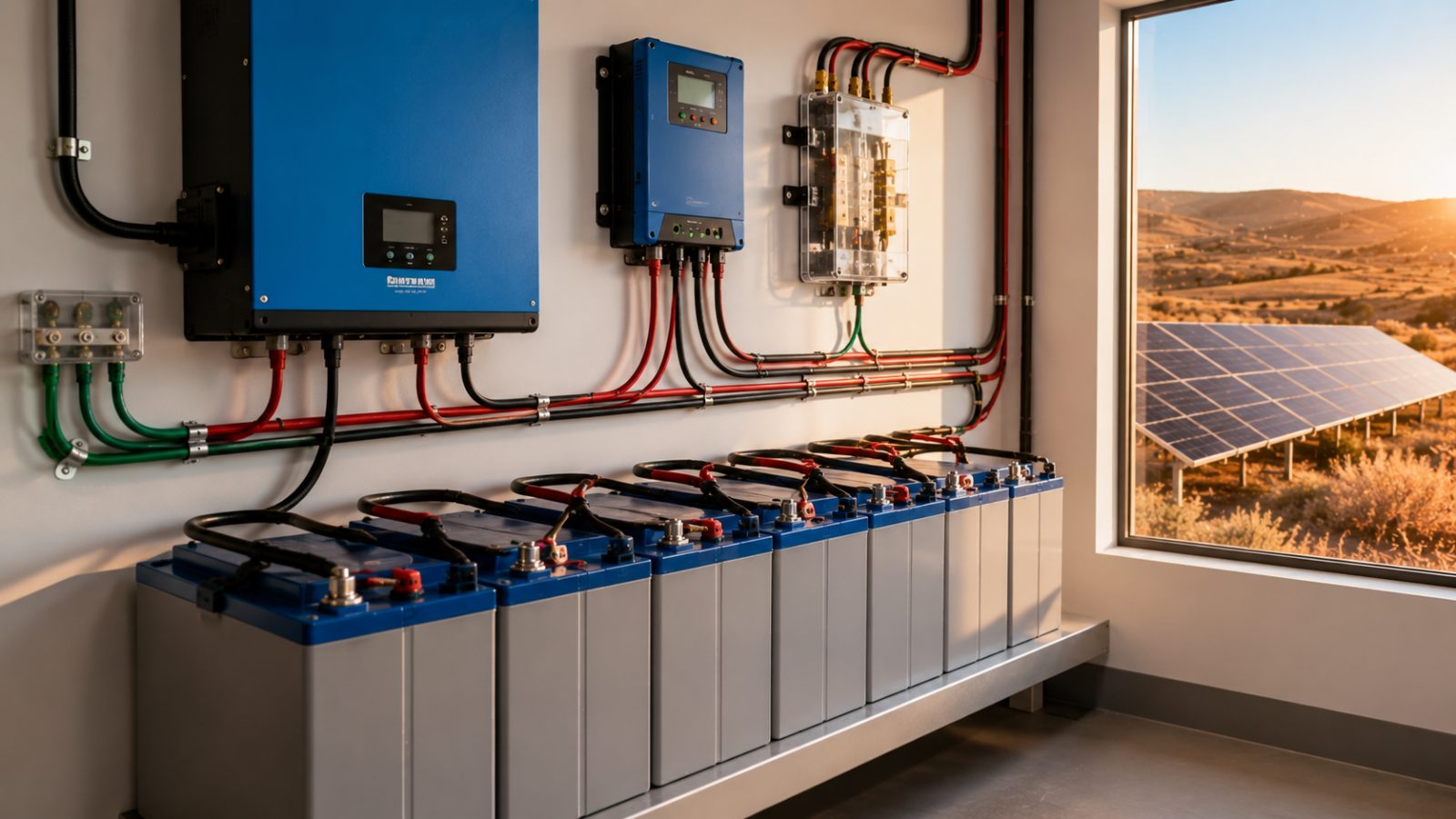
Panels get all the attention, but they're only half of an off-grid system. Your panels make power when the sun's up; your battery bank is what keeps the lights on at 2 a.m. in February. Size it too small and you'll be sitting in the dark during the first cloudy stretch. Size it too big and you've buried money in the ground. Here's how to get it right — the simple way.
The whole idea, as the U.S. Department of Energy puts it, is that solar isn't always made when you need it — so a battery charged by your panels stores that daytime power for use after dark or during a cloudy stretch.
The four numbers you need
Battery sizing comes down to four things. Nail these and the math is easy:
- Daily energy use (watt-hours). How much power you burn in a day. If that number's fuzzy, start with our guide on what your appliances actually use.
- Days of autonomy. How many cloudy, low-sun days you want the bank to carry you through without a charge.
- Depth of discharge (DoD). How much of the battery you can actually use before you have to recharge it. This is where battery type matters a lot.
- System voltage. 12V, 24V, or 48V. This converts your storage target into amp-hours.
- (1,650 Wh × 2 days) ÷ 0.80 = 4,125 Wh of storage
- 4,125 Wh ÷ 12 V = ~344 Ah → round up to four 100Ah LiFePO4 batteries (400Ah)
- (1,650 Wh × 2 days) ÷ 0.50 = 6,600 Wh of storage
- 6,600 Wh ÷ 12 V = 550 Ah → round up to six 100Ah AGM batteries (600Ah)
- An MPPT charge controller sized to your battery voltage and panel array — it's also what lets you run slightly mismatched panels efficiently (more on that in mixing different-wattage panels).
- A pure sine wave inverter if you're running household AC appliances.
- A battery monitor / shunt so you actually know your state of charge instead of guessing.
- Properly sized wire and fuses — non-negotiable for safety.
- 12V 100Ah LiFePO4 batteries (with low-temp cutoff) — the off-grid workhorse; build your bank from these.
- 12V 100Ah AGM deep-cycle batteries — the budget route for light-use cabins.
- MPPT solar charge controllers — match the amperage to your array.
- Pure sine wave inverters — sized to your biggest AC load plus a surge margin.
- Battery monitors / shunts — cheap insurance against killing your bank.
The formula
Here's the whole thing in one line:
Battery storage (Wh) = (Daily watt-hours × Days of autonomy) ÷ Depth of discharge
Then turn watt-hours into amp-hours (the number on the battery label) by dividing by your system voltage:
Amp-hours (Ah) = Battery storage (Wh) ÷ System voltage (V)
If "watt-hours" and "amp-hours" aren't second nature yet, our plain-English primer on watts, amps, and volts clears that up in a couple of minutes.
A worked example
Say your daily use comes out to 1,650 watt-hours a day (a few lights, a laptop, and a modest fridge — the same example from our watts & volts post). You want 2 days of autonomy so a cloudy weekend doesn't leave you stranded, and you're building a 12-volt system.
With lithium (LiFePO4) you can safely use about 80% of the battery:
With lead-acid (AGM) you should only use about 50% before recharging, so you need a bigger bank for the same job:
Same exact loads — and the lead-acid bank has to be roughly 50% bigger just because you can't drain it as deep. That's the single biggest reason people end up choosing lithium for off-grid. (Round up, and don't sweat a little extra — real systems lose 10–20% to inverter and charging inefficiency, and the rounding usually absorbs it.)
One note on system voltage: those amp-hour numbers are at 12V. Build the same bank at 24V or 48V and the amp-hours drop by half or three-quarters for the same stored energy — which means thinner wire and smaller fuses. That's exactly why bigger off-grid builds run at 48V.
Lead-acid (AGM) vs. lithium (LiFePO4)
| AGM Lead-Acid | LiFePO4 Lithium | |
|---|---|---|
| Usable depth (DoD) | ~50% | ~80–100% |
| Cycle life | ~300–700 cycles | ~3,000–5,000+ cycles |
| Typical lifespan | 3–5 years | 10–15 years |
| Upfront cost | Lower | Higher (but cheaper per usable kWh over its life) |
| Weight | Heavy | ~⅓ the weight for the same usable energy |
| Maintenance | Some (and needs ventilation) | Essentially none |
Short version: AGM is cheaper to walk out the door with; lithium is cheaper over the life of the system and far more forgiving. For a weekend cabin you rarely use, AGM can pencil out. For a full-time off-grid home, most folks land on LiFePO4.
The eastern Washington cold-weather gotcha
This is the one that catches people around here, so pay attention: a LiFePO4 battery must not be charged below freezing (32°F / 0°C). Charging a frozen lithium battery permanently damages it. In an Oroville winter, an unheated shed or trailer will absolutely hit those temps.
Two fixes: buy LiFePO4 batteries with a built-in low-temperature cutoff (most quality ones have it — they simply refuse to charge when it's too cold) or with self-heating, or keep the bank in a space that stays above freezing. Lead-acid doesn't have the freeze-charging problem, but it loses a chunk of its capacity in the cold — so either way, winter is when your bank works hardest. Plan your days of autonomy around winter, not summer. (Our take on eastern Washington sun hours shows just how short the December days get.)
Don't forget the rest of the system
Batteries don't work alone. To actually use them you'll also want:
What you'll need — and where to get it
We'll be straight with you: WA Solar Depot is a panel shop (batteries and balance-of-system gear are on our roadmap, but not in the yard yet). So here's honest guidance on the rest, with links to solid options on Amazon. Look for established names like Battle Born, LiTime, Renogy, ExpertPower, or SOK:
And of course, the panels that charge it all are right here in our shop — used commercial panels from $65.
Bottom line
Add up your daily watt-hours, pick your days of autonomy (plan for winter), divide by your battery's usable depth, and convert to amp-hours. Round up, keep lithium above freezing when charging, and don't skimp on the charge controller and wiring. Do that and your bank will carry you through the dark months without drama.
Want a second set of eyes on your numbers before you buy? That's what we're here for. Call or text us at (509) 341-0559, or start with our full off-grid system sizing guide to tie the panels, batteries, and inverter together.
Ready to get your panels?
We have stock on hand in Oroville, WA. Local pickup, honest prices.
Shop Solar PanelsGet notified when new stock arrives
No spam. Just stock alerts and occasional sale notices.